
Solicitors’ Accounts Chapter 7: Conveyancing accounts and other accounts
August 2026
The SRA has issued guidance on the use of third party managed accounts.
Third-party managed accounts
Using joint accounts or operating a client’s own account is only appropriate when it meets the needs of an individual client.
However, third party managed accounts (TPMAs) can meet the needs of law firms as well as of clients. For example, some law firms choose not to operate their own client accounts and prefer to outsource the responsibility for looking after money belonging to clients and others to a third-party business which manages the money in third-party managed accounts. This is permitted under Rule 11.1. Firms can use one or more TPMAs and can also operate their own client account(s) alongside using a TPMA(s). For example, a firm might choose to use their own client account(s) for lower-value private client transactions such as residential conveyancing or probate, while using a TPMA(s) for higher-value corporate or commercial transactions. The SRA has issued specific guidance for firms who choose to use third-party managed accounts.
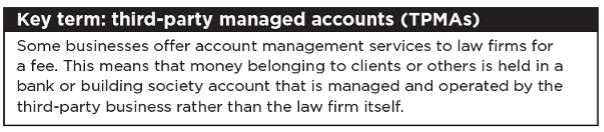
Money belonging to clients or other third parties held in a TPMA does not fall under the definition of ‘client money’ as it is not held by the law firm. Therefore, the firm does not have to comply with the stringent requirements of the Rules relating to client money and client accounts. Other advantages for firms in using a TPMA(s), if they choose to do so instead of using their own client account, include:
- avoiding the costs associated with operating client accounts, for example, paying for professional indemnity insurance cover for risks to client money (insurance to protect firms from liability, for example, if a client loses money due to a solicitor’s negligence in managing the client account), and instructing accountants to prepare reports (see Chapter 8); and
- reducing the risk of money laundering, fraud or cybercrime. (See Revise SQE: The Legal System and Services of England and Wales for more details on money laundering.)
However, firms must ensure that they only use TPMAs where it is in the best interests of their clients to do so, and where they are satisfied that the money belonging to clients or third parties will be safeguarded by the TPMA provider.
If using a TPMA, firms have certain obligations to both the SRA and to their clients. These include:
- checking that the TPMA provider is properly regulated by the Financial Conduct Authority (FCA);
- checking that the interest arrangements offered by the TPMA provider are appropriate;
- completing a TPMA notification form to send to the SRA as soon as the firm starts or stops using any TPMA – the form requires details of the TPMA provider, together with its authorisation number from the FCA (the SRA does not need to give permission for a firm to use a TPMA, but the notification requirements enable the SRA to keep an accurate and up to date record of which TPMAs are being used by which firms);
- informing clients of the firm’s arrangement with the TPMA provider and checking that clients understand any implications of this before accepting their instructions (Rule 11.1(b)). Firms should give a transparent and clear explanation of the terms of the firm’s contract with the TPMA provider to their prospective clients, including specific information on how the TPMA fees are paid and who bears the cost (Rule 11.1(b)(i)). They should also tell the client of their right to terminate the agreement and dispute payment requests made by the firm (Rule 11.1(b)(ii)); and
- obtaining regular copies of statements from the TPMA to ensure that they accurately reflect any transactions (Rule 11.2). To do this effectively, firms should keep accurate internal records of any transactions to cross check against the TPMA statements.